When a drone fell on a building in Dubai Creek Harbour on 12 March, the fire it caused was minor and no injuries were reported. The question it left behind is larger: had the damage been to your car, your flat or to you, which of your insurance policies would have paid? For war damage in the UAE, standard insurance policies mostly say no, with one important exception: emergency health care in Dubai. This is what each type of policy does, the add-ons that now exist, and what they cost.
The short answer
Standard UAE insurance policies typically exclude war, according to AM Best research reported by Khaleej Times in April 2026, and the cover is sold instead as add-ons. That holds for car policies and most home policies, and travel policies usually exclude war and airspace closures too.
The exception is emergency medical care in Dubai: a directive in force since October 2025 requires health insurers to cover emergencies until the patient is stabilised, whatever the cause. After that, your policy wording decides.
War add-ons now exist for cars at Sukoon and GIG Gulf, and a broker quoted by The National put entry-level prices at around AED 90. Orient sells political violence cover for homes and vehicles. Sukoon’s add-on runs from the day you buy it and GIG Gulf’s starts 48 hours after purchase, so neither pays for damage that happened before.
If debris has already damaged your car or home, claim anyway and ask for any refusal in writing: whether interception debris counts as war damage turns on the wording.
Why this is a real question in 2026
Since 28 February 2026 the UAE has come under waves of Iranian missile and drone attacks, separated by pauses, with its air defences engaging them as they come in. The UAE’s Ministry of Defence reported two ballistic missiles launched from Iran on 18 August, one of them landing inside the country’s territorial waters, and a drone from Iran intercepted over those waters on 31 August. Iran denied the 18 August attack. On 12 March alone, Dubai Media Office reported a minor fire after a drone fell on a building in Dubai Creek Harbour, debris from an interception hitting a building facade on Sheikh Zayed Road, and a drone crash in Al Bada’a. No injuries were reported in any of the three.
The UK Foreign Office page on the UAE, last updated on 24 July 2026 and still current on 16 September, describes Iranian strikes and retaliation in the region since 8 July, a risk of escalation and possible airspace closures. It does not advise against travel, and its shelter advice says the greatest risk is from falling debris caused by intercepts. For insurance, the losses most residents are likely to face are practical ones: a car under falling debris, a cracked window, a flight home that does not leave. Those are the claims where war exclusions come into play.
The clause that decides it
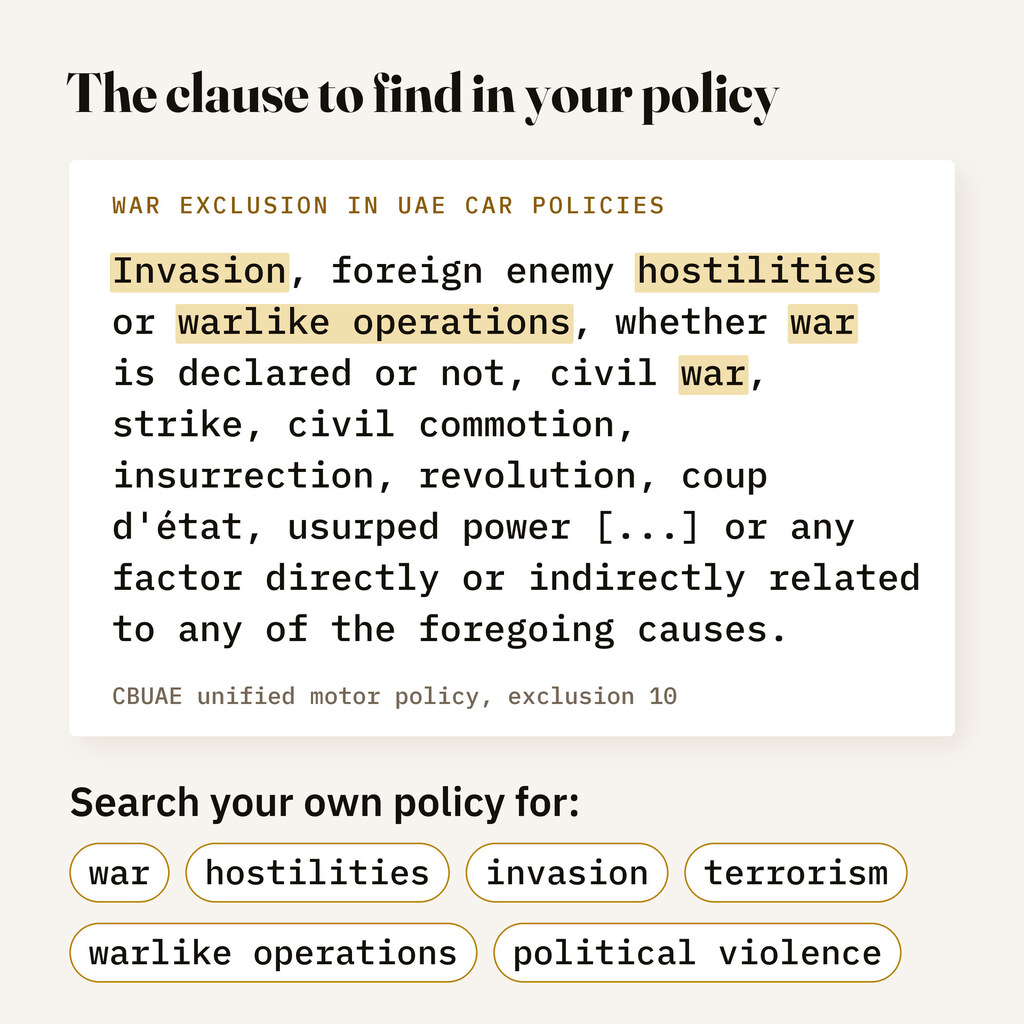
Look for the exclusions. In a UAE car policy, war is item 10 in the exclusions chapter of the unified motor policy published by the Central Bank of the UAE, and comprehensive car policies share that wording. Home, travel and other policies phrase it their own way and may put it elsewhere: the ILOE terms list it among their eligibility conditions. The motor version, shown above, excludes invasion, foreign enemy hostilities or warlike operations, whether war is declared or not, civil war and civil commotion, and any factor directly or indirectly related to them.
The definition is what matters: Ibrahim Karam, chief executive of R2S Insurance Brokers, told The National that cover typically responds to falling debris that causes physical damage, but that exclusions may apply for war-related risks, depending on how they are defined. We found no common published position among UAE insurers on whether debris from a successful interception counts as war damage. Read the clause before you need it, and get the answer in writing.
Policy by policy: what pays
This is the position we could document on 16 September 2026. Each row except life insurance is explained further down.
| Policy | Standard cover | What changes it |
|---|---|---|
| Car, comprehensive | Excluded | War cover bought before the damage: an add-on to a Sukoon or GIG Gulf comprehensive policy (GIG’s starts 48 hours after purchase), or Orient’s political violence cover for personal vehicles |
| Home and contents | Usually excluded | Orient’s political violence cover for residential units |
| Health, in Dubai | Emergency care | Covered until you are stable, whatever the cause, on a Dubai-regulated policy. After that, your wording decides |
| Travel | Usually excluded | Emirates’ Comprehensive Travel Cover adds conflict medical cover up to US$25,000 and a free trip extension of up to 30 days |
| Job loss, ILOE | Excluded | Nothing: loss of work based on the state’s declaration of war is excluded |
| Life | Check wording | No published position found: ask your insurer in writing |
Car: the add-ons, and what they cost
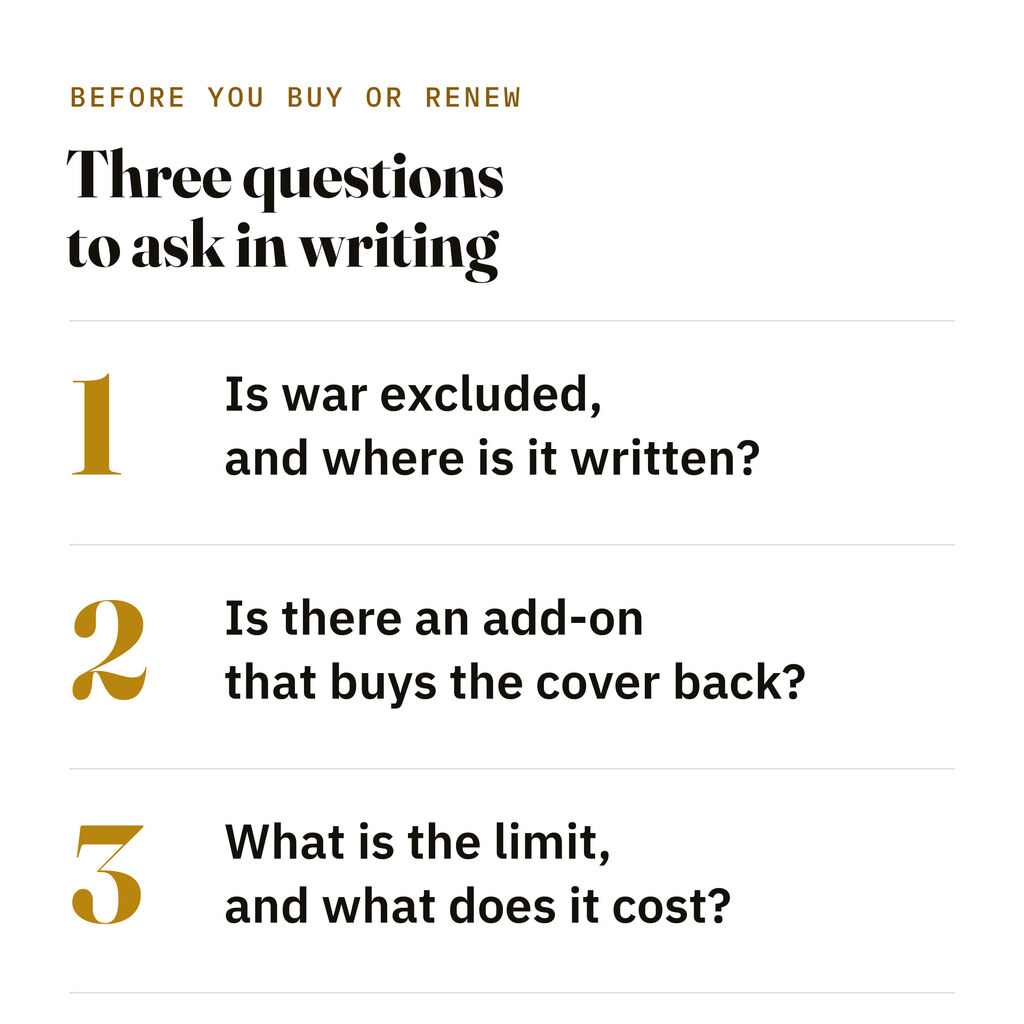
A comprehensive motor policy does not pay for war damage. The unified motor policy published by the Central Bank of the UAE lists war among its exclusions, item 10, alongside invasion, hostilities and civil commotion. Julien Audreire, an executive vice president at Sukoon, told The National in May 2026 that war, terrorism and warlike operations remain standard exclusions under conventional motor policies, although terrorism is not named in exclusion 10 itself. At least three insurers now sell a way to buy that cover back.
| Insurer | Who can buy it | Limit | Price |
|---|---|---|---|
| Sukoon | Holders of a Sukoon individual comprehensive motor policy only | The car’s insured value, up to AED 5 million | Not published. Priced pro rata on the car’s insured value and the time left on the policy |
| GIG Gulf | Private saloons, sedans, SUVs and 4WDs on Motor Prestige, Motor Perfect Plus or Motor Perfect | Up to the full vehicle value less depreciation, or AED 100,000, or AED 50,000 | 0.5% additional premium, amount confirmed when you buy; active 48 hours after purchase |
| Orient | Owners of personal vehicles | Not published | Not published |
Across the market, entry-level prices for car war add-ons start at around AED 90, according to a broker quoted by The National in May 2026. GIG describes its price as 0.5% more on your premium but also says it depends on your vehicle value and chosen sum insured, so ask for the figure in dirhams before you buy.
Read the conditions as closely as the price. GIG’s cover starts 48 hours after you buy it, and claims in that window are not covered. Sukoon sells its add-on only with its own individual comprehensive motor policies, so a driver with third-party cover, or with comprehensive cover from another insurer, has nothing to attach it to. GIG’s product page excludes any loss at, or within 500 metres of, a military base, defence site or marine port, and airport or airside operations. Both add-ons cover the UAE only, keep your usual motor excess and cannot be cancelled or refunded once issued. Both end when your main policy does, so they have to be bought again at renewal.
Falling debris is less clear-cut. Ibrahim Karam of R2S Insurance Brokers, quoted above, told The National that comprehensive motor policies, unlike third-party cover, pay for accidental damage such as falling debris, subject to how the war exclusion is worded. If debris damages your car, claim anyway and ask for any refusal in writing.

Home: why most households are not covered
Most household insurance contracts contain war exclusions, The National noted in April 2026. The product that buys them back, political violence insurance, was mainly bought by businesses: in April, Sanjay Bhagwan Babur, chief executive of Cosmos Insurance Brokers, put its rates at 2.5% to 5% depending on location, against 0.1% to 0.2% before the conflict.
For individuals, the change came on 14 May 2026, when Orient Insurance launched Political Violence, including War, for Residential Units, which its parent company Al-Futtaim says protects homeowners and residents, alongside a version for personal vehicles. Orient published no prices with the launch. The comparison site Policybazaar.ae, in a guide updated in August 2026, says the cover typically starts from AED 2,500 for AED 250,000 of cover, at 1% to 1.75% of the sum insured.
If you rent, the building is not yours to insure. In a jointly owned building such as an apartment block, Dubai law requires the management company to insure it, and the owners pay for that through their service charges. Your belongings are yours, and a standard contents policy is likely to carry the usual war exclusion, so ask Orient whether its residential cover will insure a tenant’s contents alone before assuming it does.
For a small group of UAE nationals, possibly. Cabinet Resolution No. 135 of 2026, in force since 15 August 2026, allows financial assistance of up to AED 350,000 for damage to a home and essential household items in a qualifying crisis or disaster, for UAE national families already receiving federal or local social support, on the basis of an official damage report. Cars are excluded. Khaleej Times, which reported the rules on 25 August 2026, describes a general crisis and disaster scheme and did not say whether damage from attacks counts.
For expatriate residents we found no equivalent public scheme as of 16 September 2026. The relief measures Gulf News listed in May, such as bank loan deferrals and a three-month deferral of some Dubai government fees, deal with cash flow, not damage.
Health: emergency care is covered, the rest depends
This is the one place where Dubai’s rules override the exclusions. The Dubai Health Insurance Corporation’s emergency coverage directive, effective 27 October 2025, requires health insurance policies to cover all emergency conditions up to stabilisation, irrespective of the underlying cause, including causes excluded under standard policy terms. Where no other insurance exists, the directive adds, the health insurer remains liable for all the costs up to that point. Stabilised has a set meaning in the directive: stable enough to be moved to another hospital, or stable on vital signs but not yet fit to be moved, so it can come before you are discharged.
The same directive requires insurers to cover emergencies regardless of network, and not to reject or delay those claims over network, location or pre-authorisation. After stabilisation, the directive says treatment follows the terms, limits and pre-authorisation rules of your own policy, so follow-up surgery, rehabilitation or a longer hospital stay are assessed under its wording, including any war exclusion.
This is a Dubai rule: it binds insurers, hospitals and employers regulated in Dubai. Abu Dhabi’s Department of Health sets its own rules, and in the northern emirates mandatory cover for private-sector workers has been set at federal level since 1 January 2025. If your policy was issued elsewhere, check which regulator it answers to. Our guide to health insurance costs explains how Dubai policies are tiered and priced.
Travel: the foreseeability trap, and the new conflict cover
War, military activity and airspace closures are typically listed under travel policy exclusions, Roger Zaccar, chief executive of the comparison site Yallacompare, told Gulf News in March 2026. A policy bought before a conflict escalated, or before a travel advisory was issued, may keep some protection. A trip booked once the situation was widely known may be classed as foreseeable, which can limit cover. This conflict has been widely known since the end of February 2026, so if you buy a standard policy now, do not count on cover for losses linked to it without the insurer’s answer in writing. Medical emergencies abroad usually stay covered, even in a country in conflict, Toshita Chauhan of Policybazaar.ae told the paper, as long as they are not directly caused by war or civil unrest.
One product we found now includes conflict cover. Emirates’ Comprehensive Travel Cover, launched on 17 June 2026 with Travel Guard, adds conflict cover that reimburses medical expenses up to US$25,000 and a free trip extension of up to 30 days, and Emirates states that the cover is not restricted by government travel advice. It is sold on emirates.com at booking or through Manage Booking, in markets that include the UAE and the UK. Emirates also manages hotel stays during disruptions, including airspace closures, as an airline service rather than an insurance benefit. Terms and conditions apply, and coverage and availability may vary by market, so read the policy wording for your market before relying on the conflict cover.
Whatever you buy, check one line: whether the cover depends on your government’s travel advice for the destination. Our travel insurance guide covers the other exclusions that catch people out.
Job loss: ILOE carries its own exclusion
The UAE’s compulsory job loss scheme has a war clause too. Its policy terms make a claim ineligible when the loss of work is based on the state’s declaration of war, declared or undeclared, hostilities, invasion, civil war or civil commotion, among other events.
We found no official declaration of war by the UAE in 2026, and the Ministry of Foreign Affairs said on 8 April 2026 that the UAE is not a party to this war. The policy terms do not define the state’s declaration, so do not assume a claim will be refused.
An ordinary redundancy, decided by an employer for business reasons in a difficult year, is assessed on the usual conditions, including 12 consecutive months of paid cover, no resignation or disciplinary dismissal, and a claim within 30 days. The policy terms do not say how a claim is treated when the two overlap, and we found no published guidance. Our ILOE guide walks through the claim itself.
If something is damaged: the first days
Once everyone is safe, the paperwork below is what any claim, refusal or support application will turn on.
- Photograph everything before it is moved Wide shots and close-ups, with the date on your phone, including the street or car park and anything that shows the cause.
- Get the official report Ask the police or civil defence at the scene which document they issue. The federal scheme for nationals requires an official damage report, and the UAE’s unified motor policy requires drivers to notify the authorities immediately after an accident that may lead to a claim.
- Tell your insurer in writing straight away, even if you expect a no Policies set time limits for reporting a loss: the UAE’s unified motor policy, for one, requires you to tell the insurer promptly. Quote your policy number, and ask for any refusal in writing with the exclusion clause it relies on.
- If you rent, write to your landlord the same day In Dubai, the tenancy law makes the landlord responsible for repairs unless your contract says otherwise. A dated message also protects your deposit: the law does not make a tenant hand the property back free of damage due to reasons beyond their control.
- Keep every receipt Towing, a hotel night, replaced glass. If cover exists anywhere, it will be claimed against receipts.
Questions we get asked
- Does car insurance cover drone or missile debris damage in the UAE?
- Not if your insurer treats it as war damage. Comprehensive policies exclude war, but a broker told The National they cover accidental damage such as falling debris, so the answer turns on your policy’s wording. Claim anyway, and ask for any refusal in writing. Cover written for war comes from an add-on or policy bought before the damage, from Sukoon, GIG Gulf or Orient.
- Is there home insurance that covers war damage in Dubai?
- Yes, but it is new and specific. Orient Insurance launched Political Violence, including War, for Residential Units on 14 May 2026 without published prices. The comparison site Policybazaar.ae says it typically starts from AED 2,500 for AED 250,000 of cover, so ask Orient or a broker for a quote. Most standard household contracts exclude war.
- Will my health insurance pay if I am injured in an attack?
- If you hold a Dubai health insurance policy, emergency treatment must be covered until you are stabilised, whatever caused the injury, under the Dubai Health Insurance Corporation directive effective 27 October 2025. Treatment after stabilisation depends on your policy wording, and other emirates set their own rules.
- Does travel insurance cover trips from the UAE during the conflict?
- Usually not for losses caused by the conflict. War, military activity and airspace closures are typical exclusions, and a trip booked once the situation was widely known can be treated as foreseeable. Emirates sells a Comprehensive Travel Cover with conflict medical cover up to US$25,000, in markets including the UAE and the UK.
- Can I claim ILOE if I lose my job because of the war?
- Not if the loss of work is based on the state’s declaration of war or similar events, which the ILOE policy terms exclude. An ordinary redundancy is assessed under the usual conditions, so claim within 30 days and ask for any refusal in writing.
- Does the UAE government compensate residents for war damage?
- Not for expatriate residents: we found no public scheme for them as of 16 September 2026. Cabinet Resolution No. 135 of 2026 offers up to AED 350,000 for home damage in a crisis or disaster, but only to UAE national families already receiving social support.
- UK Foreign, Commonwealth and Development Office, UAE travel advice updated 24 July 2026, still current when read on 16 September 2026
- Gulf News for the 12 March incidents in Dubai, citing Dubai Media Office, on day 13 of the war
- Al Jazeera for the 18 August missile launches reported by the UAE Ministry of Defence, and Iran’s denial, 19 August 2026
- Khaleej Times for the drone from Iran intercepted on 31 August 2026
- Central Bank of the UAE, unified motor policy, exclusions for exclusion 10, read 16 September 2026
- Central Bank of the UAE, unified motor policy, obligations of the insured for notifying the authorities and the insurer, read 16 September 2026
- Khaleej Times for AM Best research on standard exclusions and add-ons, 20 April 2026
- The National for household exclusions, falling debris and political violence pricing, 9 April 2026
- The National for the Sukoon motor war add-on and the AED 90 entry-level price, 15 May 2026
- Sukoon, War Cover for eligibility and terms, read 16 September 2026
- GIG Gulf, War Cover product page for limits, price, the 48-hour start and exclusions, read 16 September 2026
- GIG Gulf for how its War Cover works, read 11 September 2026
- Gulf News for the four Orient war risk products, 14 May 2026
- Al-Futtaim, Orient Insurance announcement for the residential and vehicle products and who they protect, May 2026
- Policybazaar.ae for indicative pricing of Orient’s residential cover, updated August 2026
- Dubai Law No. 6 of 2019 on jointly owned real property for building insurance in jointly owned buildings
- Dubai Law No. 26 of 2007 on landlord and tenant relations for repairs and returning the property
- Dubai Health Insurance Corporation, Emergency Coverage Policy Directive effective 27 October 2025, for emergency cover, stabilisation and scope
- Gulf News for travel exclusions and foreseeability, quoting Yallacompare and Policybazaar.ae, 12 March 2026
- Emirates media centre for Comprehensive Travel Cover, 17 June 2026
- ILOE policy terms and conditions for the war exclusion and eligibility conditions in the job loss scheme
- UAE Ministry of Foreign Affairs for the statement that the UAE is not a party to the war, 8 April 2026
- Khaleej Times for Cabinet Resolution No. 135 of 2026, 25 August 2026
- Gulf News for the relief measures since March 2026, updated 12 May 2026
Found a clause in your policy you cannot make sense of? Ask us what to put to your insurer.
Ask us your question