The price of ILOE insurance is the easy part. The costly mistakes happen elsewhere: a fine that holds up your next work permit, or a claim refused after a year of premiums because it went in on day 31. The deadline is written into the scheme’s own policy terms, a six-page document few people open, and the fines come from a ministerial resolution. We read the terms, the law behind them and the official claims guide.
The short answer
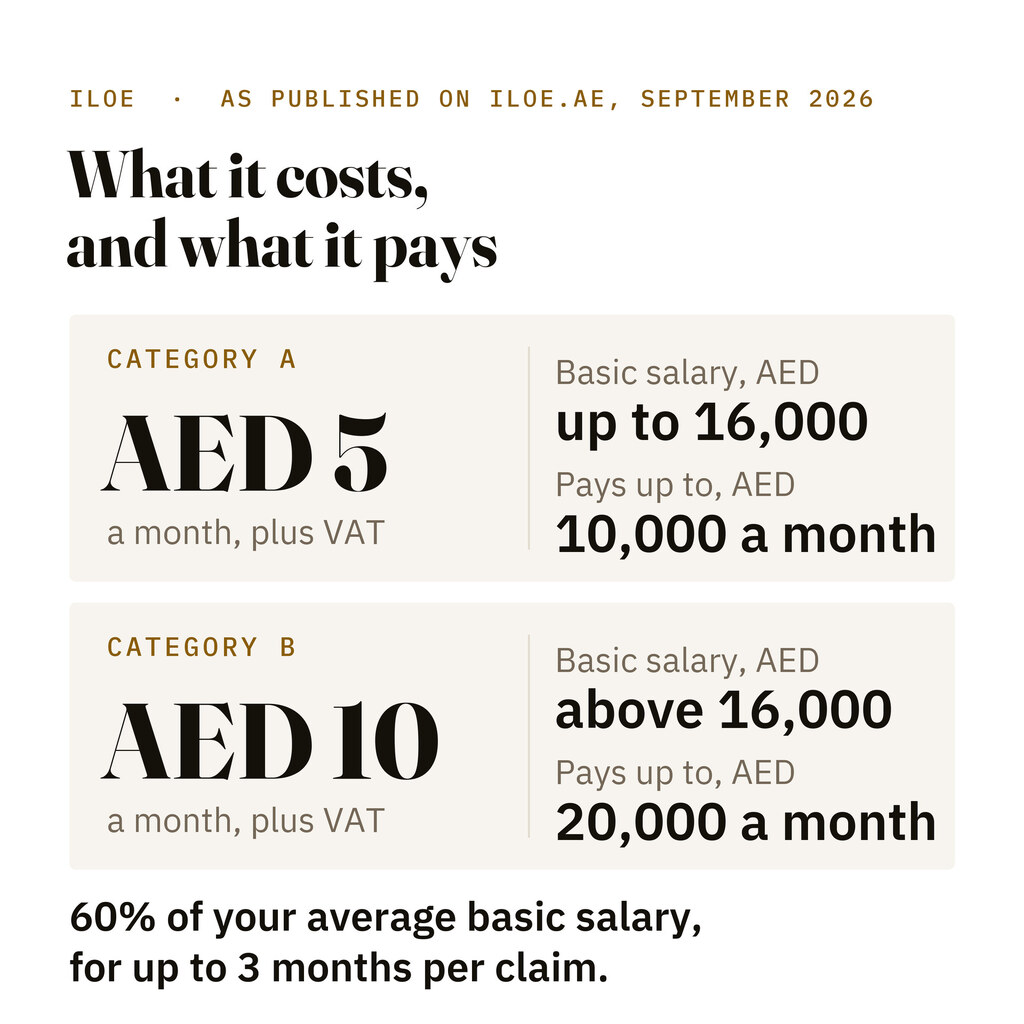
ILOE, the Involuntary Loss of Employment scheme, has been compulsory for private sector and federal government employees since 1 January 2023. The premium is the employee’s to pay: AED 5 a month if your basic salary is AED 16,000 or less, AED 10 above that, plus VAT.
If you lose your job involuntarily after 12 consecutive months of cover, it pays 60% of your average basic salary for up to three months, capped at AED 10,000 a month in Category A and AED 20,000 in Category B. Resignation and disciplinary dismissal are the best-known exclusions, not the only ones.
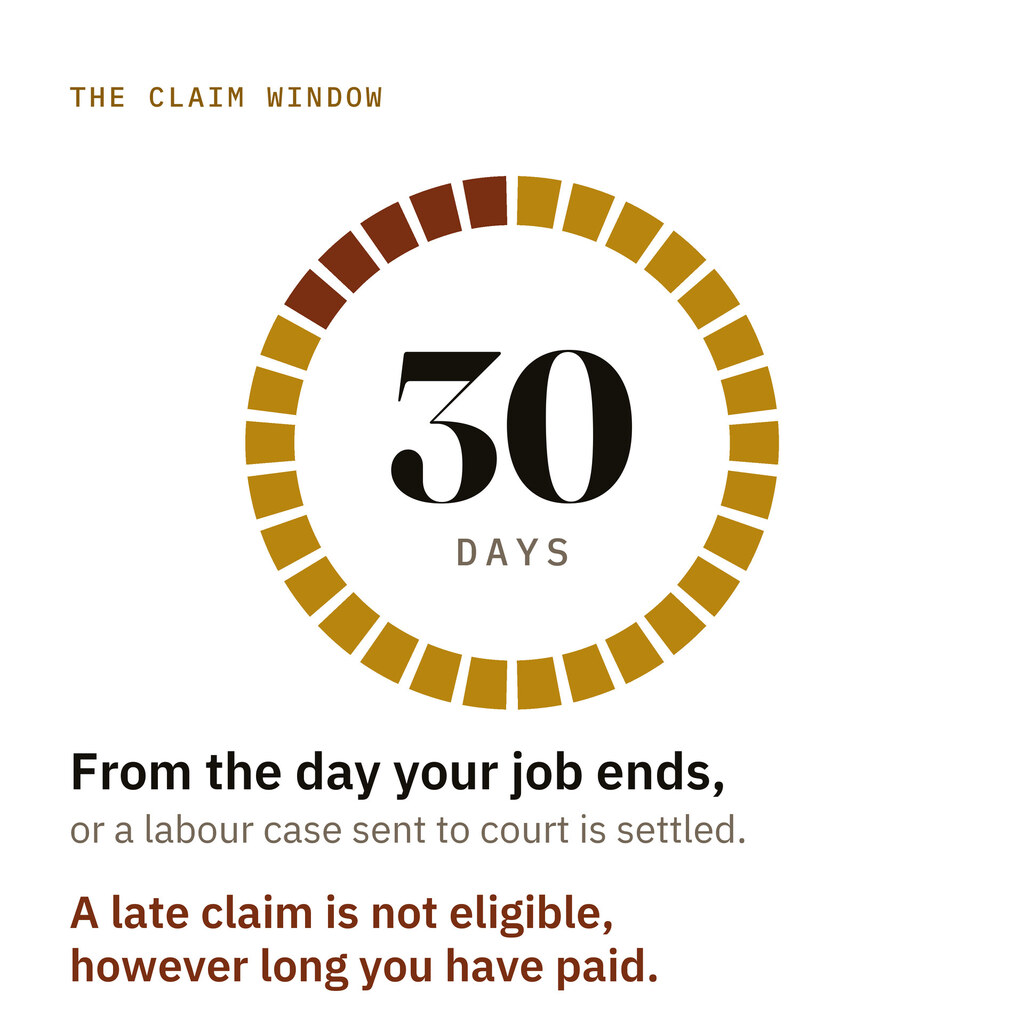
Two rules cost people money: the claim must go in within 30 days of the job ending, and a premium left unpaid for more than 90 days brings an AED 200 fine which, like the AED 400 fine for never subscribing, can hold up your next work permit.
Who has to subscribe, and who is left out
ILOE was created by Federal Decree-Law No. 13 of 2022 and has been compulsory since 1 January 2023 for employees in the private sector and the federal government. It is run by an insurance pool managed by Dubai Insurance. It is also separate from the health cover your employer has to provide in Dubai, which our guide to compulsory insurance explains.
Article 3 of the law leaves five groups out entirely. Outside those five, the open question is employees of free zones, semi-government bodies and local government.
- Mainland private sector employees, registered with MoHRE
- Federal government employees
- Staff paid on commission, who pick their own category when the contract sets no basic salary
- Investors who own the whole business and run it themselves
- Domestic workers
- Workers on temporary contracts
- Anyone under 18
- Retirees receiving a pension who have joined a new employer
Free zone and semi-government employees have been able to join since May 2023, through a “Non-Registered in MoHRE” option on the ILOE portal, Khaleej Times reported at the time. Whether they must join has had conflicting answers. In May 2023, Khaleej Times reported that an official had confirmed it was mandatory, and EY’s tax alert of 31 May 2023 said the same for free zone workers outside the DIFC. In June 2023, Fragomen reported that the DIFC and ADGM had clarified that employees of companies registered there are not required to subscribe. In October 2023, the ministry said on X, and a ministry official confirmed to The National, that free zone, semi-government and local government employees have the option to register.
Our reading: in the DIFC and ADGM it is not required. Elsewhere, the most recent ministry statement we found, from October 2023, calls it optional. Either way, a two-year Category A policy costs AED 126 with VAT, less than a third of the AED 400 fine for anyone who is required to join, and it buys you real cover. We would subscribe.
What it costs, and which category you are in
One number decides your category: your basic salary. The only exception is staff paid on commission whose contract sets no basic salary, who choose their own category. The policy terms work from basic salary alone, so housing and transport allowances count for nothing, first when your premium is set and again when a claim is calculated.
| Category | Basic salary | Premium | Benefit ceiling |
|---|---|---|---|
| A | AED 16,000 or less | AED 5 a month plus VAT | AED 10,000 a month |
| B | Above AED 16,000 | AED 10 a month plus VAT | AED 20,000 a month |
A policy runs for one or two years. On new policies, the sources disagree about how you can pay. The policy terms still published on iloe.ae list monthly, quarterly, six-monthly and yearly payments, and The National described the same options in June 2025. But Edenred, whose C3Pay app is one of the listed payment channels, reported in January 2024 that the pool had stopped accepting instalments for new subscriptions, which must now be paid in full. Renewal is clearer: Gulf News reported in February 2025 that the only renewal option is now two years, and The National says renewing subscribers are offered a single two-year payment. iloe.ae still says the full VAT is added to the first instalment or payment, so check the payment options the portal gives you when you subscribe.
That puts a two-year renewal at AED 126 in Category A and AED 252 in Category B, VAT included. Paying on the ILOE website or app costs nothing extra. You can also subscribe or renew through Al Ansari Exchange, Tawjeeh and Tasheel centres, upay and MBME kiosks, the C3Pay and Botim apps, or an SMS to 2120, with a service charge added.
What it pays, worked through
The benefit is 60% of your average basic salary over the six months before the job ended, paid monthly for up to three months per claim and capped by category. Over your whole working life in the UAE, the total is capped at 12 months of benefit, however many claims that takes.
| Basic salary | Category | Paid a month | Maximum per claim |
|---|---|---|---|
| AED 6,000 | A | AED 3,600 | AED 10,800 |
| AED 12,000 | A | AED 7,200 | AED 21,600 |
| AED 16,000 | A | AED 9,600 | AED 28,800 |
| AED 25,000 | B | AED 15,000 | AED 45,000 |
| AED 40,000 | B | AED 20,000 (capped) | AED 60,000 |
The table shows what the brochures leave out. If your basic salary is still AED 16,000 or less, the Category A ceiling never applies, because 60% of AED 16,000 is AED 9,600. It does apply if you subscribed in Category A and your average basic salary has since passed AED 16,666: the payment then stops at AED 10,000. The policy terms let you ask to pay the higher premium once a raise is in your contract, applied to past and future payments on the same certificate, and The National advises updating your details on the ILOE portal when a new job puts you in the other category. The Category B ceiling starts to bite once your average basic salary passes AED 33,333. And three months is a maximum, not a promise: payments stop as soon as another employer hires you. If you are already looking, here is who is hiring and what they pay.
Once a claim arrives with documents that meet the conditions, the policy terms give the insurer two weeks to transfer the money to the account you choose.
How to claim, step by step
You file the claim yourself, through the ILOE claims portal, the ILOE app or the call centre on 600 599 555. The steps below follow ILOE’s current claims submission guideline, which has separate sections for private sector employees, federal government employees and employees not registered with MoHRE.
- Make sure your work permit has been cancelled ILOE’s claim brochure advises cancelling it before you submit. In the private sector, the form then shows the cancellation date and reason held on record.
- Log in with your Emirates ID or UID number and your mobile Use the number you subscribed with, your date of birth and your UAE mobile number in the 5x-xxxxxxx format, then enter the one-time code sent to that number.
- Open Claim Submission and check your contact details If your email or phone number is out of date, the guideline says to call 600 599 555.
- Confirm the date and reason your job ended In the private sector the form shows what is on record: if it is wrong, add a remark and upload documents that prove it. Federal government employees, and staff of employers not registered with MoHRE, which is the route free zone employees use, select the reason and last working day themselves and upload their documents.
- Choose how you want to be paid A bank transfer needs your bank name, IBAN, account number and account holder name, and the guideline warns that the system does not check the IBAN. For an exchange house, you choose the provider, and the form shows the Emirates ID and passport numbers on record: call 600 599 555 if either has changed.
- Submit, then watch your email Updates go to your registered email address. Questions go to claims@iloe.ae or 600 599 555.
- The document ending your employment, with the date and the reason on it
- If you are in a labour case against your employer, an undertaking to send the final court ruling once it is issued
- Your IBAN, copied from a bank statement or app rather than typed from memory
- Federal government, or an employer not registered with MoHRE: your Emirates ID, passport and visa, employment contract, termination letter, residency cancellation (not needed for UAE and GCC nationals or Golden Visa holders), a bank statement, any active labour complaint and an entry and exit report (not needed for UAE nationals), 5 MB in total at most
Why claims are turned down
Every condition below comes from the policy terms. Miss one and the claim fails, however long you paid.
| Condition | What it means for you |
|---|---|
| No resignation | The scheme covers an involuntary loss of work only. If you resigned, there is no claim. |
| No disciplinary dismissal | A dismissal on disciplinary grounds is excluded. |
| 12 consecutive months | You need 12 consecutive months of subscription, with no break of more than three consecutive months. |
| Premiums up to date | A payment more than 90 days late cancels the certificate and counts as a break. |
| Claim within 30 days | Counted from the end of the job, or from the settlement of a labour complaint sent to court. |
| No absconding complaint | An open absconding complaint against you blocks the claim. |
| Legal residence | You must be legally resident in the UAE. |
| No fraud | A claim built on false details, or on an employer that turns out to be fictitious, is refused. |
| No non-peaceful strike | Loss of work caused by labour strikes or stoppages that were not peaceful is excluded. |
| Not a war-related job loss | Loss of work based on the state’s declaration of war, hostilities or civil unrest is excluded, as is one based on a nuclear or pollution event, contamination linked to terrorism, or a government seizure of the employer. Our guide to war exclusions covers your other policies. |
The residency condition has a practical edge. In a statement reported by Gulf News in December 2023, the ministry said the right to compensation is forfeited if you cancel your residency and leave the country, or join a new job, during the processing period, and Khaleej Times lists leaving the UAE among the events that stop payments. Filing before you fly out will not keep the payments coming once you have gone, so if you plan to leave, call ILOE on 600 599 555 before you cancel your visa or leave.

The fines, and what they hold up
There are two. AED 400 if you never subscribed, and AED 200 if a premium is more than 90 days overdue, which also cancels your certificate and breaks your cover. The National confirmed both amounts in June 2025.
The enforcement comes from a ministerial resolution, which Khaleej Times set out in September 2023, weeks before the 1 October sign-up deadline. An employee with unpaid ILOE fines will not be issued a new work permit until they are paid, and a fine still unpaid three months after its due date can be deducted from wages through the Wage Protection System, from the end-of-service gratuity or by any other method the ministry accepts.
You can look up fines on the Ministry of Human Resources and Emiratisation website or app. Better still, never earn one: when your certificate arrives, put the renewal date in your calendar with a reminder a month ahead, and pay through the ILOE site or app, where there is no service charge.
Questions we get asked
- Is ILOE mandatory for free zone employees?
- It is not settled. Free zone staff have been able to join since May 2023. EY described enrolment as mandatory for free zone workers outside the DIFC in May 2023, while a ministry official quoted by The National in October 2023 said it was optional. The DIFC and ADGM clarified in 2023 that their employees are not required to subscribe, and we have found no later statement. A two-year Category A policy costs AED 126 including VAT.
- Can I claim ILOE if I resign?
- No. The scheme pays only after an involuntary loss of work. Resignation and dismissal for disciplinary reasons are both excluded in the policy terms.
- How much will ILOE pay me?
- 60% of your average basic salary over the six months before the job ended, for up to three months per claim. The monthly payment is capped at AED 10,000 in Category A and AED 20,000 in Category B, and the total over your whole working life in the UAE is capped at 12 months of benefit.
- Does my employer pay for ILOE?
- The premium is the employee’s responsibility. EY noted in 2023 that employers may pay on an employee’s behalf and recover the cost, so check your contract or ask HR before assuming it is covered.
- What happens if I stop paying?
- A payment more than 90 days late cancels your certificate, breaks your cover and brings an AED 200 fine. Never subscribing carries AED 400. Unpaid fines block a new work permit, and a fine still unpaid three months after its due date can be deducted from wages or gratuity.
- How long does an ILOE claim take to pay?
- The policy terms give the insurer two weeks from receiving a claim with compliant documents to transfer the money. That clock depends on the documents meeting the conditions, so cancel your work permit before filing, as ILOE advises, and have proof ready if the end date or reason on record is wrong.
- ILOE, official scheme website for premiums, categories, policy period and payment channels, read 16 September 2026
- ILOE policy terms and conditions for eligibility, exclusions, the 30-day and 90-day rules and the two-week payment
- ILOE claims submission guideline for the claim steps, documents and payment methods, edition linked on iloe.ae on 16 September 2026
- ILOE claim brochure for the claim channels and cancelling the work permit before claiming
- Federal Decree-Law No. 13 of 2022, unofficial English translation published by ILOE for Article 3 and the exempt groups
- Khaleej Times for the ministerial resolution on work permits and deductions, and when benefits stop, 11 September 2023
- The National for fines, payment options and renewal, June 2025
- Gulf News for two-year renewals, February 2025
- Edenred for the end of instalments on new subscriptions, 29 January 2024
- Gulf News for the ministry on losing compensation after leaving the country, 13 December 2023
- EY tax alert for the 1 January 2023 start, free zones, the DIFC and payment by employers, 31 May 2023
- The National for the ministry on optional registration and a lawyer on Ministerial Resolution No. 604 of 2022, 4 October 2023
- Khaleej Times for free zone access through the Non-Registered in MoHRE route, 3 May 2023
- Khaleej Times for an official describing enrolment as mandatory, 8 May 2023
- Fragomen for the DIFC and ADGM clarifications, 8 June 2023
Lost your job and unsure whether the claim will hold? Ask us before the 30 days run out.
Ask us your question