
Some English guides to dressing in Dubai, such as UAE Expert Hub’s (updated March 2026), still cite a UAE government portal page that now returns a 404. So we went to the law itself, to the emirate’s own tourism board, and to the places that publish their own dress rules. The rules are narrower than you have been told.
The short answer
There is no law setting a dress code in Dubai. Visit Dubai, the emirate’s own tourism board, states there are no specific restrictions on what you can wear at any time of year.
What the law punishes is a public indecent act, and its text never names clothing. Dubai Police told Gulf News that an outfit which amounts to public indecency, such as going to a mall in nothing more than a swimsuit, will lead to action.
Mosques set real dress requirements, and Sharjah next door has written decency rules. In Dubai, malls, family attractions and parks often display dress code guidelines at their entrances. Everywhere else is convention.
There is no Dubai dress code, and that is the real answer
The most useful sentence on the subject is published by Dubai’s own Department of Economy and Tourism: “While there are no specific restrictions on what you can wear in Dubai anytime of the year, visitors are advised to be mindful of the local culture and religion and to ensure they are dressed appropriately for the occasion.” The same page notes that with more than 200 nationalities living in the city, all attires are generally acceptable.
Read the official copy closely and the verbs give it away. Visit Dubai writes try and, recommended, advisable, appreciated. It never writes must about clothing. Even for mosques, it speaks of specific requirements and says visitors should dress modestly. That is not just diplomacy. Dubai Police told Gulf News that there is no law in the UAE forcing people to dress in a certain way, although respect for the country’s religion, culture and heritage is expected.
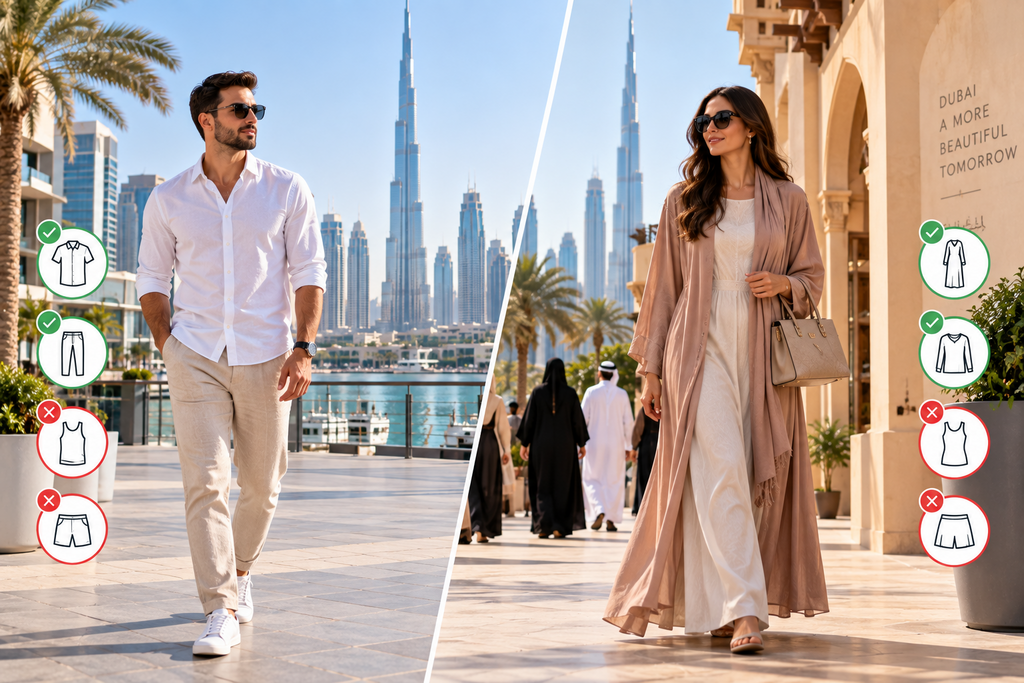
Visit Dubai lists two things to avoid. One is clothing with offensive slogans or images, or anything that could be insulting to any religion, faith or culture. The other is very revealing clothing, such as swimwear, in places that are not the pool or the beach. Its packing list also suggests clothing that covers the shoulders and midriff for public areas.
What the law says, and the mistake guides still repeat
The provision that applies is Article 411 of Federal Decree-Law No. 31 of 2021. It punishes anyone who publicly commits an indecent act with incarceration or a fine of AED 1,000 to AED 100,000. A repeat offence carries up to three months’ imprisonment and/or a fine of AED 10,000 to AED 200,000. The same article also covers anyone who says or does anything against public morals. Search the text for the words dress, clothing, garment or swimwear and you will not find them.
Some guides, UAE Expert Hub’s among them, still cite Article 358 and a six-month minimum detention, and that guide even attributes the article to the 2021 decree. Article 358 belongs to the 1987 penal code, which the 2021 decree explicitly repealed with effect from 2 January 2022. Public indecency is now Article 411, and the disguise offence is Article 412, in the part of the 2021 code headed Flagrant and Indecent Acts (Articles 411 to 413). If a page still quotes Article 358 in 2026, its legal section has not been checked since before the current code came into force.
There is a second reason old wording lingers. The same guide sources its dress rules to the Social responsibility page on the UAE government portal, and that page returned a 404 when we checked on 16 September 2026. The source has gone offline, so the lines quoted from it can no longer be checked against the original.
What to wear as a woman
Day to day, dress as you would in any modern city. Gulf News describes it the same way, and adds that there are no specific restrictions on women’s clothing. Shoulders and knees covered is the convention people describe, and it is worth following around the Creek and in Al Fahidi, where Visit Dubai recommends sleeved tops and trousers, or skirts and shorts past the knee. It is a courtesy, not a condition of entry.
Swimwear, including bikinis, is explicitly permitted at beaches, public pools, waterparks and spa facilities. The line to watch is the edge of those places. Visit Dubai says swimwear is not appropriate in business districts and shopping malls. When Dubai Police gave Gulf News an example of an outfit that amounts to public indecency, it was a trip to a mall in nothing more than a swimsuit. Cover up before you leave the sand or the pool deck.
Dubai Police described their approach to Gulf News in a piece first published in June 2012 and last updated on 15 September 2018. Officers only step in when someone lodges a complaint. A first offence means signing an undertaking not to repeat it, and legal action follows if it happens again. The same piece gives a sense of scale: the director of the Port Police station said 259 people had signed undertakings for dressing inappropriately on the beach in the first four months of 2012.
You do not need an abaya. There is no requirement for a non-Muslim woman to wear one, or to cover her hair, anywhere outside a mosque. If you want one anyway, for comfort in the heat or for an occasion, we have a guide to what they cost and where to buy.

What to wear as a man
Visit Dubai tells men that loose-fitting trousers and knee-length shorts will serve them well during the day, so knee-length shorts in the city are fine. Leave them behind for a mosque visit. What to avoid is going shirtless away from a beach or pool, which comes under the same advice as swimwear out of place rather than any Dubai rule aimed at men. We could find no documented case of anyone penalised for the length of their shorts.
One provision does single men out. Article 412 of the same 2021 law carries up to a year in jail and/or a fine of up to AED 10,000 for a man who disguises himself as a woman to enter a women-only space. It concerns access, not fashion.
For offices, no law sets a dress code: that is a matter between you and your employer. In summer, the item you are most likely to need at work is a light layer for the air conditioning.
Emirati men wear the kandura, an ankle-length garment also called dishdasha or thawb, with the ghutra headscarf and the black iqal cord. The bisht, the cloak worn over it at weddings and other special occasions, was added to UNESCO’s intangible heritage list in 2025, in a joint file from the UAE and eight other Arab states.
A UAE media policy restricts the wearing of Emirati national dress in advertisements and social media content to UAE citizens. Khaleej Times traces it to an April 2025 session of the Federal National Council, where National Media Office chairman Abdulla Al Hamed said the rule does not aim to limit the use of the dress. Explaining it in May 2026, Dr Jamal Al Kaabi, secretary-general of the National Media Authority, said it is fine for presenters of other nationalities to wear their own clothes. Its scope is media content, not everyday clothing.

Where a real dress code applies
Mosques set requirements you have to meet to enter, and Sharjah next door has written decency rules. Some Dubai venues post guidelines of their own. Outside these places, the advice above is convention rather than rule.
Mosques
Jumeirah Mosque publishes a genuine code: for women, arms, legs and hair covered; for men, no shorts and no sleeveless tops. You do not need to arrive dressed for it. Abayas and sheilas for women, and kanduras for men, are lent to visitors who need them, and the centre states all garments are hygienically cleaned and maintained. The public guided visit costs AED 55 per person, light Emirati refreshments included. It runs at 10:00 and 14:00, Saturday to Thursday, with registration opening 30 minutes before each session. It is closed on Fridays and needs no advance booking.
Sheikh Zayed Grand Mosque in Abu Dhabi publishes a stricter version for women: loose to the ankles, sleeves to the wrists, full hair coverage, nothing transparent or tight. Men are advised to cover the whole leg and to avoid transparent, tight or sleeveless shirts. Not every mosque lends clothes. Visit Dubai advises women to carry a headscarf and says only some mosques let visitors borrow abayas.
Malls, attractions and government offices
Gulf News reported in December 2025 that shopping malls, family attractions and parks often display dress code guidelines at their entrances, so check the sign before you walk in. Government service centres are less clear. We could not find a dress code published by the RTA for its service centres. A UAE lawyer quoted in the 2012 Gulf News piece said some officials in government bodies may choose to ban certain outfits, such as very short or transparent clothes. Some court staff, the lawyer added, refuse to serve people who are dressed inappropriately. If you have an appointment at a service centre, dress conservatively.
Sharjah, next door
Sharjah is a different emirate with its own written decency rules, issued in 2001 and reported by Khaleej Times. For women, clothing that exposes the stomach or back, is above the knee, or is tight or transparent is treated as indecent. For men, the same goes for very short shorts in public places and a bare chest. Swimmers on beaches should wear conservative swimwear, and swimwear is not allowed on streets or in public places. Enforcement starts gently: the rules tell public employees to advise violators first, and Gulf News reported that police give a verbal warning. If you commute or day-trip there, the rules genuinely differ.
What to wear, by season
The real constraint in Dubai is not modesty. It is heat, and then air conditioning.
| Months | Average high | Average low | What that means in practice |
|---|---|---|---|
| June to September | 40 to 42 °C | 27 to 30 °C | Nights barely cool. Loose, light, pale, and a layer for indoors |
| October and May | 36 to 39 °C | 24 to 25 °C | Shoulder season. Still hot at midday, pleasant after dark |
| April | 34 °C | 21 °C | Warm days and mild evenings. Still beach weather |
| November to March | 24 to 31 °C | 15 to 20 °C | The season people live outdoors. January evenings want a jacket |
In August the average high sits close to 42 °C and the average low near 30 °C, so there is no cool part of the day to plan around. The UAE bans outdoor work in direct sunlight between 12:30 and 15:00 from 15 June to 15 September, and 2026 was the twenty-second consecutive year of that rule. It tells you what the middle of the day is like.
The counterintuitive part is indoors. Visit Dubai notes that indoor spaces are always air-conditioned, and suggests a light shawl or jacket for malls, indoor attractions and cinemas. The summer item you actually need is something to put on, not to take off. The same guide calls November to April beach weather, and a January evening is cool enough for a jacket.
During Ramadan there is no dress code imposed. Modest clothing that covers the shoulders and knees is encouraged as a mark of respect, for men and women alike. Visit Dubai says there are no restrictions on eating or drinking in public for people who are not fasting, though you may choose not to do so around those who are, out of respect. Khaleej Times adds that there is no formal ban on smoking in public either. The fast itself runs from dawn to sunset. Ramadan 2027 is expected to begin around 8 February, depending on the moon sighting.
Questions we get asked
- Is there actually a fine for dressing wrongly in Dubai?
- Not for clothing as such. Article 411 of Federal Decree-Law No. 31 of 2021 punishes a public indecent act with incarceration or a fine of AED 1,000 to AED 100,000, and a repeat offence with up to three months’ imprisonment and/or a fine of AED 10,000 to AED 200,000. The text never mentions clothing. The example Dubai Police gave Gulf News is going to a mall in nothing more than a swimsuit. In 2012 they said officers only step in when someone lodges a complaint, although the Port Police station made 259 people sign undertakings over inappropriate beachwear in the first four months of that year.
- Do women have to cover their hair in Dubai?
- No, and there is no requirement for a non-Muslim woman to wear an abaya either. The exception is inside a mosque, where covering up is required to enter. Jumeirah Mosque lends abayas and sheilas to visitors who need them, but Visit Dubai advises carrying a headscarf and says only some mosques let visitors borrow abayas.
- Can men wear shorts in Dubai?
- Yes. Visit Dubai says knee-length shorts will serve men well during the day. Avoid them for a mosque visit, and avoid going shirtless away from a beach or pool, which comes under the same advice as swimwear out of place rather than any Dubai rule about men specifically.
- Can I wear a bikini in Dubai?
- Yes, at beaches, public pools, waterparks and spa facilities, where it is explicitly permitted. Cover up before you leave. Visit Dubai says swimwear is not appropriate in business districts and shopping malls, and going to a mall in nothing more than a swimsuit is the example of public indecency Dubai Police gave Gulf News.
- What should I wear during Ramadan?
- There is no dress code imposed during Ramadan. Modest clothing that covers the shoulders and knees is encouraged as a mark of respect. There is no ban on eating or drinking in public for people who are not fasting, and no formal ban on smoking, but it is considerate to avoid doing so around those who are fasting, from dawn to sunset.
- Are the rules the same across the UAE?
- No. Sharjah has its own written decency rules covering clothing, issued in 2001, and swimmers on its beaches should wear conservative swimwear. It is next door to Dubai, so this matters if you commute or take a day trip there.
- Visit Dubai (Department of Economy and Tourism), What to wear in Dubai: your holiday packing list for the no-specific-restrictions quote, the 200 nationalities line, the verbs it uses, the two things to avoid, shoulders and midriff, swimwear in business districts and malls, the Creek and Al Fahidi advice, knee-length shorts for men, the mosque advice and borrowed abayas, the light layer for air-conditioned malls and November to April as beach weather, 17 April 2026
- Visit Dubai, Practical information for swimwear at beaches, waterparks, public pools and spa areas, conservative dress being appreciated, the specific requirements for entering a mosque, and its use of must only for local laws and prescriptions, read 16 September 2026
- Visit Dubai, Ramadan FAQs for no restrictions on eating or drinking in public for people who are not fasting, the courtesy of avoiding it, and fasting from dawn to sunset, read 16 September 2026
- UAE Legislation portal, Federal Decree-Law No. 31 of 2021 (Crimes and Penalties Law) for Articles 411 to 413 and their penalties, the repeal of the 1987 penal code and entry into force on 2 January 2022, read 16 September 2026
- Khaleej Times, UAE law: Dh10,000 fine for insults, indecent acts in public or social media for the text of the old Article 358 and its six-month minimum detention, 17 May 2021
- UAE Expert Hub, Dress Code in Dubai: What Tourists and Residents Should Know for a 2026 guide that still cites Article 358, attributes it to the 2021 decree and relies on the UAE government portal page, updated March 2026
- Gulf News, What exactly does the law say about dressing indecently in the UAE? for Dubai Police on the absence of a dress law, complaint-led action, undertakings and the swimsuit-in-a-mall example, the 259 beach undertakings in early 2012, the lawyer on government offices and courts, and the Sharjah verbal warning, first published June 2012, last updated 15 September 2018
- Gulf News, Visiting Dubai? Here are five key rules tourists should know before arriving for swimwear including bikinis at beaches, public pools, waterparks and spa facilities, no specific restrictions on women’s clothing, and dress code guidelines at malls, family attractions and parks, 13 December 2025
- Jumeirah Mosque, Public Mosque Visit (Sheikh Mohammed Centre for Cultural Understanding) for the AED 55 admission with light refreshments, the 10:00 and 14:00 sessions, registration 30 minutes before, Saturday to Thursday opening, the Friday closure and no advance booking, read 16 September 2026
- Jumeirah Mosque, Dress Code for Jumeirah Mosque for the dress code for women and men, the abayas, sheilas and kanduras lent to visitors and the cleaning of garments, read 16 September 2026
- Sheikh Zayed Grand Mosque Centre, Mosque manners for the visitor dress code for women and men, read 16 September 2026
- Khaleej Times, Kanduras for Emiratis only on social media: Top UAE official explains reason behind move for the national dress rule in advertisements and social media, its April 2025 origin at the Federal National Council, and the statements by Abdulla Al Hamed and Dr Jamal Al Kaabi, 18 May 2026
- UNESCO Intangible Cultural Heritage, Bisht (men’s Abaa), skills and practices for the 2025 inscription, the occasions it is worn for and the nine submitting states, the UAE among them, read 16 September 2026
- Khaleej Times, Decency rules: What they are for the Sharjah rules issued on 16 June 2001, the dress codes for women and men, swimwear, and advice before police action, published 30 July 2009, updated 5 April 2015
- Khaleej Times, Ramadan 2026: Rules, etiquette to follow in UAE for no dress code during Ramadan and modest clothing covering shoulders and knees for men and women, 9 February 2026, updated 16 February 2026
- Khaleej Times, Ramadan 2026 in Dubai: Can you eat during the day? Common questions answered for no restrictions on eating and drinking in public for people who are not fasting, no formal ban on smoking, and fasting from dawn to sunset, 25 February 2026
- Khaleej Times, UAE midday break starts June 15; work under direct sunlight banned during peak afternoon hours for the 12:30 to 15:00 ban on outdoor work from 15 June to 15 September and its 22nd consecutive year in 2026, 8 June 2026
- Gulf News, How far away is Ramadan 2027? Here’s the latest expected date for Ramadan 2027 expected to begin on 8 February, subject to the moon sighting, last updated 14 September 2026
- Open-Meteo Historical Weather API, ERA5-Land reanalysis (grid point 25.2 N, 55.3 E) for the 1996 to 2025 monthly average highs and lows in the table and the August figures, computed 16 September 2026
Heading somewhere specific and not sure what it expects? Ask us.
Ask us your question
