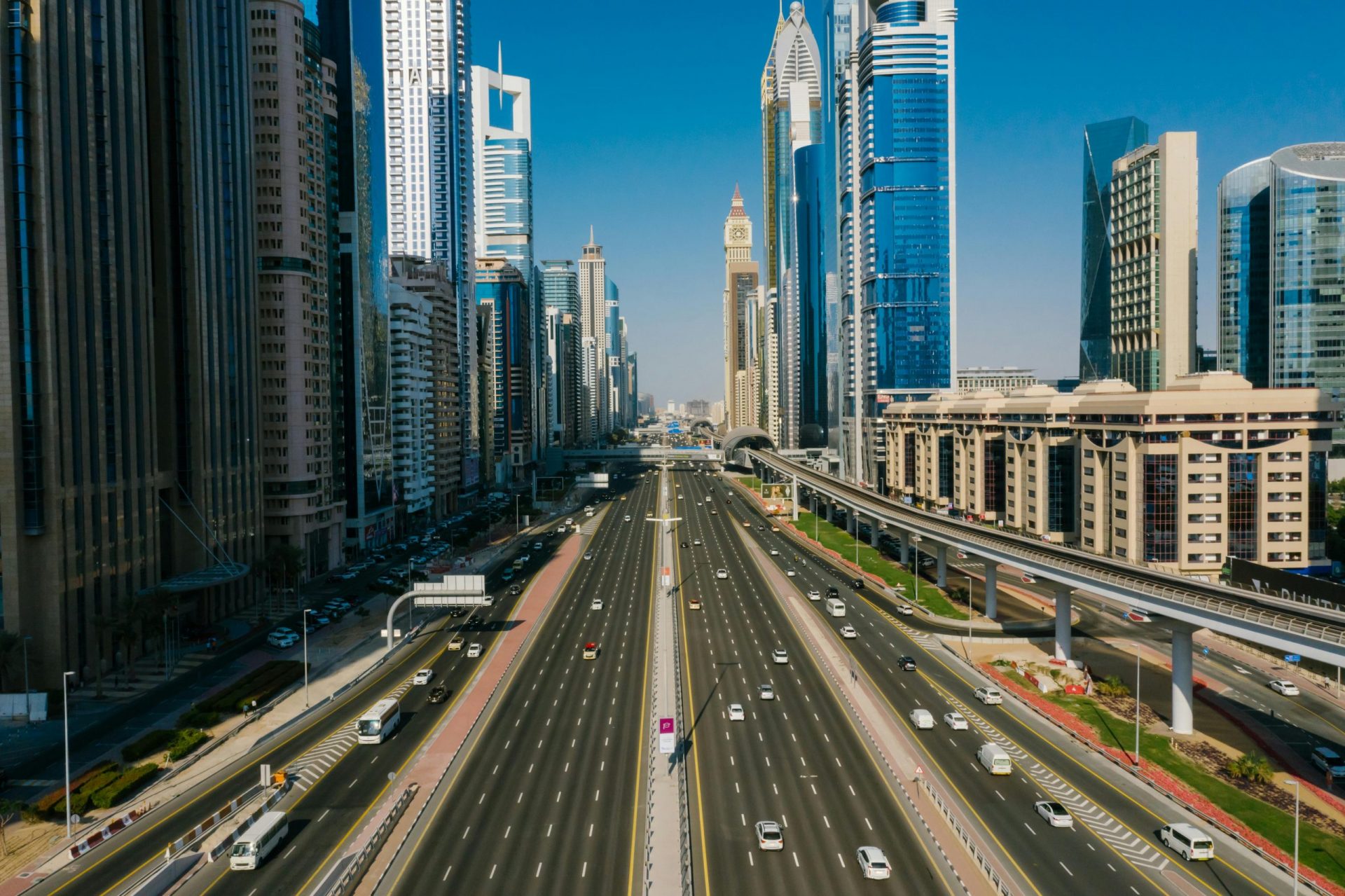
Dubai is often described as if it appeared from nothing. It did not. It was a trading port before it was anything else, and almost every decision that built the modern city was an attempt to keep being one.
The short answer
Dubai’s rise rests on a handful of deliberate bets: dredging the Creek, building Jebel Ali, creating free zones, and treating the airline and the airport as national infrastructure.
Oil helped pay for some of the early bets, but the economy now rests on other sectors. In the first quarter of 2026, wholesale and retail trade, the largest sector, made up about 22 percent of GDP, finance and insurance 14 percent and real estate 11.2 percent.
The 2009 debt crisis nearly ended the story, and the recovery shaped everything since. In 2026, regional disruption has cut passenger traffic at the airport and container volumes at Jebel Ali.
Before oil: a port and a pearl trade
Dubai was a small settlement on a natural inlet, living on pearling and on trade with Persia and India. When the pearl market collapsed in the 1930s, after Japanese cultured pearls arrived, the town lost its main industry.
What carried it through was an older decision about tax rather than about oil. At the start of the 20th century, Sheikh Maktoum bin Hasher, ruler from 1894 to 1906, abolished most tariffs and sent an envoy to persuade the leading merchants of the Persian port of Lingah to move their businesses to Dubai. The town built a reputation as the place where business was easiest, and that reputation is arguably still the emirate’s single most valuable asset.
The decisions that built the city
- 1950sDredging the CreekThe inlet was silting up and the largest boats could no longer get in. Work began in 1959, paid for partly with loans from Dubai’s merchants and from other Gulf states, and it kept Dubai in the shipping business at the moment it might have dropped out.
- 1960The airport opensDubai International opened six years before any oil was found. It has handled 1.5 billion passengers since.
- 1966Oil found offshoreThe reserves were modest by regional standards. The revenue helped pay for roads, power and desalination, and most of all for the port at Jebel Ali.
- 1970sPort Rashid, then Jebel AliWhen Sheikh Rashid decided to build a second port, 40 km from the city centre, some feared it would take business from Port Rashid, which had opened only seven years earlier. Queen Elizabeth II inaugurated Jebel Ali in February 1979, and it became the world’s largest man-made harbour and the anchor of everything that followed.
- 1985Jebel Ali Free Zone and EmiratesThe free zone opened with 19 companies and now hosts more than 11,000. Like other UAE free zones, it puts no restrictions on foreign ownership. Emirates flew for the first time in October that year, with two aircraft leased from Pakistan International Airlines.
- 1990sTourism as strategyThe Dubai Shopping Festival launched in 1996 and drew more than 1.6 million visitors in its first year. The Burj Al Arab, the city’s first global landmark, opened in December 1999.
- 2000sProperty opened to foreignersForeigners were allowed to buy property from May 2002. The freehold law set off a surge in demand: steady growth until 2006, then a boom in 2007 and 2008.
- 2009The debt crisisDubai World asked for a standstill from creditors it owed about US$25 billion. Projects halted, prices collapsed, and Abu Dhabi stepped in. The recovery took years: the property market slumped until 2011.
- 2020sDiversification consolidatesTrade, finance, real estate, aviation and tourism carry the economy. In the first quarter of 2026, wholesale and retail trade alone made up about 22 percent of GDP.
2009, and what it taught
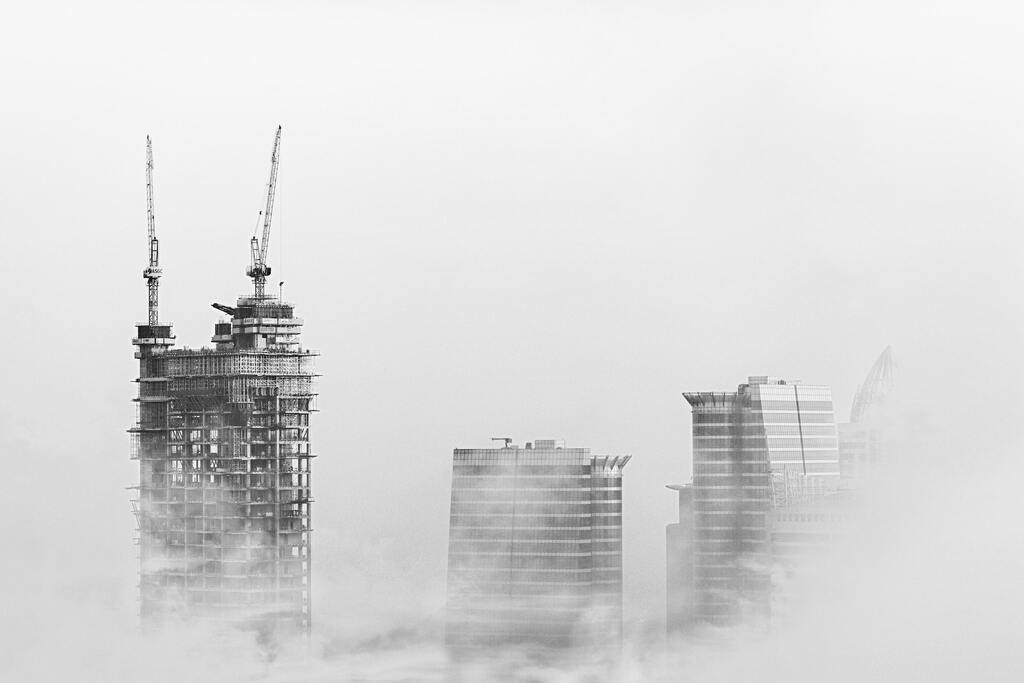
The crash was severe. Construction stopped mid-building, and the emirate needed help from Abu Dhabi to meet its obligations. Part of the US$10 billion that Abu Dhabi provided in December 2009 went to repay a US$4.1 billion Islamic bond owed by Dubai World’s property arm. A few weeks later, in January 2010, the world’s tallest building opened as Burj Khalifa. Until then it had been Burj Dubai, and the new name honoured Sheikh Khalifa bin Zayed, ruler of Abu Dhabi and president of the UAE.
Prices kept falling for two more years. By October 2011, the median estimate in a Reuters poll of 10 banks, investment firms and research institutions put the fall in home prices and rents at nearly 60 percent from their 2008 peak.
What it taught was that the growth model carried real financial risk, and that Abu Dhabi would not let Dubai fail. Both lessons still shape how the emirate borrows and builds.
Dubai is often presented either as a miracle or as a mirage. Neither holds up. It is a port city that made a series of large, deliberate, occasionally reckless bets over sixty years, lost badly on one of them, and kept going. That is a more ordinary story than either version, and a more useful one if you are moving there.
Where the city stands in 2026
Dubai ended 2025 with 4.58 million residents, a record 19.59 million international overnight visitors, and a property market that had recorded AED 917 billion of transactions over the year, including more than AED 680 billion of real estate investment deals. In December 2025, before this year’s regional disruption, Emirates NBD forecast 4.5 percent growth for 2026, and it listed easing regional tensions among the reasons. Official figures show Dubai’s GDP grew 2.4 percent year on year in the first quarter of 2026.
Against that, the year has brought a real test. Passenger traffic through Dubai International fell 31.3 percent year on year in the first half of 2026 under regional airspace constraints. Container volumes at Jebel Ali fell 90.1 percent year on year in the second quarter, to 374,000 twenty-foot equivalent units (TEU), as shipping through the Strait of Hormuz was disrupted. DP World says the port remains fully operational with no physical damage, although the regional conflict has temporarily reduced vessel traffic. In March, debris from an intercepted missile or drone caused a fire at one of the port’s berths, and operations were briefly suspended as a precaution.
Visitors are coming back. Arrivals have grown by double digits from one month to the next since March, and August’s 869,000 was the highest monthly figure since February. That brought the total for the first eight months of 2026 to 6.97 million international overnight visitors.
A city built on being the place things pass through is, by construction, exposed when passage becomes difficult. What happens next is the most interesting question about Dubai in a decade. Our guide to where the money comes from goes into the sector detail.
What you can still see
Most of this history is still standing, and almost none of it is in the tall buildings.
- Al Fahidi and the Creek. Wind-tower houses and the original merchant quarter, a few minutes from the abra crossing. This is the town the rest was built out from.
- The gold and spice souks. Working markets, not reconstructions, doing what the settlement always did.
- Al Shindagha. The former ruler’s house, on the water, at the point where the trading decisions were actually made.
- Jebel Ali, from the road. Not a tourist site, but the scale is the point. When it was planned, some feared it would simply take business from Port Rashid. Building it anyway is the whole model in one place.
An afternoon around the Creek explains more about why the city exists than any observation deck.
Questions we get asked
- Was Dubai built on oil money?
- Partly. Oil found offshore in 1966 helped pay for later infrastructure, but the reserves were modest. Two early projects came before any oil was found: the Creek dredging, begun in 1959, and the airport, opened in 1960. Oil was still about 5 percent of Dubai’s GDP in 2006. Today wholesale and retail trade is the largest sector, at about 22 percent of GDP.
- Who built the city physically?
- Overwhelmingly migrant labour. In 2006, Human Rights Watch reported that nearly all of the UAE’s more than 500,000 construction workers were migrants, mostly from India, Pakistan and Bangladesh. Working and living conditions in the sector have drawn sustained international criticism and have been the subject of reforms whose effectiveness is debated. It is part of the history and worth stating plainly.
- How did Dubai recover from 2009?
- Financial support from Abu Dhabi, a restructuring of Dubai World’s debts agreed with its banks in 2010, and several years of slower building. The Expo bid and later tourism growth carried the recovery through the following decade.
- Is the growth sustainable?
- It has survived a near-collapse once, and trade, not oil, is its largest sector. But it remains dependent on open trade and travel routes, which is precisely what 2026 has disrupted.
- Arab News, On Emirates’ glittering coast, pearl trade lives on for the collapse of the pearl trade in the 1930s after Japanese cultured pearls arrived, updated 29 November 2019
- The National, How Dubai created an environment where everyone has the chance to succeed for Sheikh Maktoum bin Hasher, ruler from 1894 to 1906, abolishing most tariffs and sending an envoy to bring the Lingah merchants to Dubai, 14 June 2016
- The National, Dubai Creek: the making of Sheikh Rashid’s first mega project for the silting Creek entrance, dredging work starting in 1959 and the merchant and Gulf loans that paid for it, 26 September 2019
- Gulf News, Dubai International Airport handles 1.5 billion passengers for the airport opening in 1960 and 1.5 billion passengers since (Government of Dubai Media Office briefing), 11 September 2026
- AAPG Explorer, Dubai’s rise from Bedouin tents to skyscrapers for the offshore Fateh-1 oil discovery on 3 August 1966, 1 January 2024
- AGBI, Contrary to urban myth, Dubai was never an oil-rich emirate for the modest reserves, output that was tiny beside Abu Dhabi and Saudi Arabia, and oil revenue spent on roads, power, desalination and Jebel Ali Port (Frank Kane), 9 January 2026
- The National, The day Queen Elizabeth II opened Jebel Ali Port in Dubai in February 1979 for Sheikh Rashid’s decision to build a port 40 km from the city centre, the fear that it would take business from Port Rashid (opened seven years earlier) and the February 1979 inauguration, 11 February 2022
- DP World, Jebel Ali Port for the world’s largest man-made harbour, undated, read 16 September 2026
- Jafza, About us for the free zone starting operations in 1985 with 19 companies and hosting over 11,000 today, undated, read 16 September 2026
- Jafza, home page for the absence of foreign ownership restrictions in UAE free zones, undated, read 16 September 2026
- The National, How Emirates took flight for the first time to begin 40 years of soaring success for the first flight on 25 October 1985 and the two aircraft leased from Pakistan International Airlines, 25 October 2025
- Gulf News, Dubai Shopping Festival’s journey of growth for the festival launch in 1996 and more than 1.6 million visitors in its first year, 30 December 2014
- The National, As Burj Al Arab turns 25, meet the people behind Dubai’s first global landmark for the opening on 1 December 1999 and the hotel as the city’s first global landmark, 29 November 2024
- Gulf News, Rise and fall: Ten years of freehold for foreigners being allowed to buy property from May 2002, the surge in demand, and the growth, boom and slump years from 2002 to 2011, 10 May 2012
- The National, 2009 a distant memory as Dubai World again in debt talks for the 2009 standstill request to creditors owed about US$25 billion and the 2010 settlement with more than 100 banks, 8 July 2014
- Al Jazeera, Abu Dhabi comes to aid of neighbour for the US$10 billion from Abu Dhabi, part of it to repay a matured US$4.1 billion Islamic bond of Dubai World’s property arm, 14 December 2009
- CBS News, World’s tallest building honors sheik for the renaming as Burj Khalifa after the ruler of Abu Dhabi and UAE president, whose emirate had come to Dubai’s rescue, 4 January 2010
- Gulf News, Burj Dubai renamed as Burj Khalifa for the opening of the world’s tallest building as Burj Khalifa, previously Burj Dubai, 4 January 2010
- Gulf News, Dubai realty prices will fall another 10% for the Reuters poll median of 10 banks, investment firms and research institutions putting the fall in home prices and rents at nearly 60 percent from the 2008 peak, 25 October 2011
- Gulf News, Oil’s share of Dubai GDP falls again for oil at 5.1 percent of Dubai’s GDP in 2006 (Dubai Chamber of Commerce and Industry), 8 June 2007
- Government of Dubai Media Office, Dubai’s GDP reaches AED232 billion in Q1 2026 for 2.4 percent growth in the first quarter of 2026, trade as the largest sector at about 22 percent, finance and insurance at 14 percent and real estate at 11.2 percent, 8 July 2026
- The National, Dubai population passed 4.5 million by end of 2025 for 4.58 million residents at the end of 2025 (Dubai Data and Statistics Establishment), 30 July 2026
- Government of Dubai Media Office, Dubai’s tourism industry achieves third successive record-breaking year for the record 19.59 million international overnight visitors in 2025 (Department of Economy and Tourism data), 9 February 2026
- Gulf News, Dubai visitor numbers hit highest level since February with 869,000 arrivals for 869,000 visitors in August, double-digit monthly growth since March and 6.97 million international visitors from January to August 2026 (Department of Economy and Tourism data), 14 September 2026
- Dubai Department of Finance, Public Debt Management Office, 2025 real estate results for AED 917 billion of real estate transactions in 2025 and more than AED 680 billion of real estate investments (Dubai Land Department figures), 12 January 2026
- Emirates NBD Research, Positive private and public sector momentum will power growth in 2026 for the 4.5 percent growth forecast for Dubai in 2026, with easing regional tensions among the drivers, 15 December 2025
- Government of Dubai Media Office, DXB enters stronger second half as capacity returns for 31.5 million passengers in the first half of 2026, down 31.3 percent on a year earlier, under regional airspace constraints, 26 August 2026
- DP World, first-half 2026 results release for Jebel Ali remaining fully operational with no physical damage while the regional conflict temporarily reduced vessel traffic, 13 August 2026
- World Cargo News, DP World H1 throughput hit by Hormuz disruption at Jebel Ali for 374,000 TEU in the second quarter of 2026, down 90.1 percent year on year, and the March berth fire and brief suspension of operations, 13 August 2026
- Human Rights Watch, UAE: Workers abused in construction boom for the more than 500,000 construction workers, nearly all migrants and mostly from India, Pakistan and Bangladesh, and the abuses reported, 11 November 2006
Want the version of this that answers a specific question? Send it over.
Ask us your question