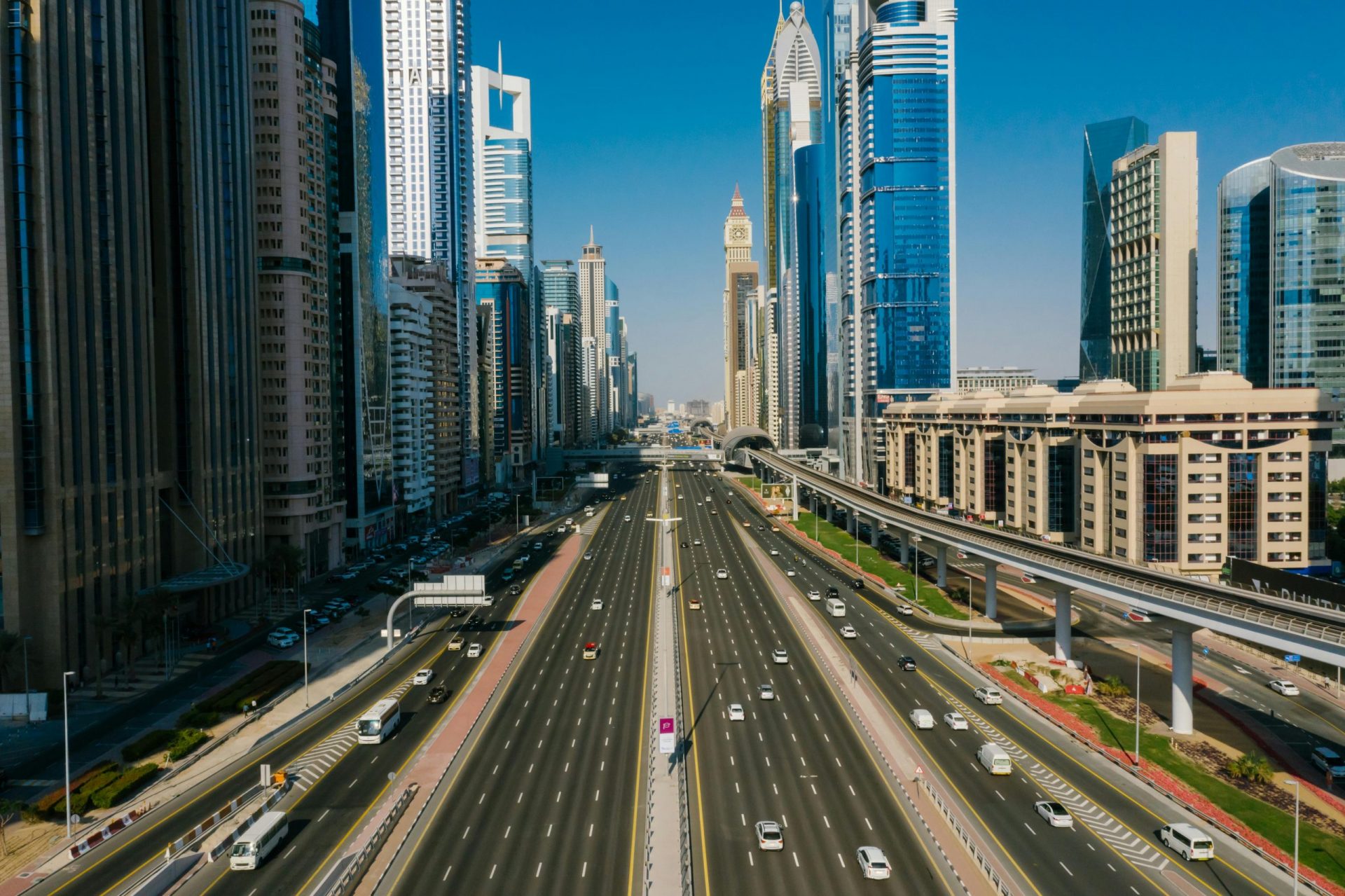
The assumption is oil. The reality is that oil is under one percent of Dubai’s economy, and its share has been shrinking since the early 1980s. What replaced it is more interesting, and in 2026 it is being tested.
The short answer
Oil accounts for less than 1% of Dubai’s GDP, down from roughly half in the early 1980s.
In the first quarter of 2026, trade was the largest slice at about 22%. Finance and insurance made up 14% and real estate 11.2%. Aviation, including the tourism it brings, supported about 27% of GDP in 2023, according to an Oxford Economics study.
In 2026 both of the emirate’s flagship gateways are under strain, and in May Fitch forecast that Dubai’s GDP would shrink by close to 7% this year. That is part of the story too.
The oil myth, in one number
Oil is under one percent of Dubai’s GDP. In the early 1980s it was about half. That single shift is the entire story of modern Dubai, and it was deliberate: the emirate’s reserves were always modest compared with Abu Dhabi’s, and the leadership knew it.
What they built instead was an economy based on being the point through which other people’s goods, money and travel pass.

Where the money actually comes from
| Sector | Share of GDP |
|---|---|
| Wholesale and retail trade | ~22% |
| Financial and insurance activities | 14% |
| Real estate | 11.2% |
| Construction | 8.1% |
| Information and communications | 5.2% |
Oil has no line of its own in the official first-quarter release, which is why it is not in the table. Transport and storage has no figure in that release either, so read the table as a selection of sectors, not a full ranking. The same release notes that Dubai revised its whole GDP series at the start of 2026.
Aviation sits across several of those categories rather than inside one. An Oxford Economics study commissioned by Emirates Group and Dubai Airports estimated that aviation, including the tourism it brings, supported AED 137 billion in gross value added in 2023, equivalent to 27 percent of Dubai’s GDP. AED 43 billion of that came from tourism that flights make possible. The estimate predates the 2026 revision and overlaps with the sectors above, so read it as a measure of scale, not a slice to add to the table. That scale explains why the airport is treated as national infrastructure rather than as a transport asset.
The model: be the place things pass through
Dubai’s strength is not making things. It moves things, stores them, finances them, and takes a margin at each step. A container arriving at Jebel Ali, a passenger connecting at DXB, a property changing hands, a company registering a licence: each generates fees, employment and activity without the emirate manufacturing anything.
Layered on top is population growth. About 4.7 million people now live in Dubai, and the Dubai Land Department recorded more than 270,000 property transactions worth AED 917 billion in 2025, a record. People arriving is itself an industry: they rent, they register, they pay fees, they enrol children in school.
What is happening in 2026
A model built on being a transit point is exposed when transit becomes difficult, and 2026 has tested exactly that. Since the regional war involving Iran began in late February, both flights and shipping have been disrupted.
Dubai International handled 31.5 million passengers in the first half of 2026, 31.3 percent below the same period in 2025, with regional airspace constraints weighing on traffic. At Jebel Ali, second-quarter container volumes fell 90.1 percent year on year, to 374,000 TEU against about 3.8 million a year earlier, as shipping through the Strait of Hormuz was disrupted. DP World says the port remains fully operational and has suffered no physical damage, although it briefly suspended operations on 1 March 2026 as a precaution after debris from an interception caused a fire at one berth.
Those are severe numbers, and it would be dishonest to write about Dubai’s economy in 2026 without them. So far they describe a disruption to flows more than to the underlying structure. The main infrastructure is still working, although it has been hit: besides the fire at Jebel Ali, a drone attack started a fire at a fuel tank near DXB on 16 March 2026, and flights were suspended as a precaution.
Growth forecasts need reading with their dates. Emirates NBD’s forecast of 4.5 percent growth for 2026 dates from December 2025, before the war. In May 2026, Fitch projected that Dubai’s GDP would shrink by close to 7 percent this year, although official figures showed 2.4 percent growth in the first quarter. Tourism has been hit: Dubai received 6.97 million international visitors from January to August 2026, against 19.59 million in the whole of 2025. The population has kept growing, by about 200,000 residents so far in 2026.
Is it resilient?
Dubai has been through this shape of problem before. The 2009 debt crisis nearly ended the story, and the recovery took a bailout from Abu Dhabi and several years. What the emirate demonstrated then was an ability to absorb a severe shock without dismantling the model.
The honest assessment for 2026 is that the diversification is real, the dependence on open trade routes is also real, and the two are in tension. Fitch does not expect a quick rebound either: its May forecast has Dubai’s real GDP still below its 2025 level in 2027. If you are moving here, that is worth knowing without being alarmed by it. The city’s history is covered in our guide to how Dubai was built, and the tax structure that underpins it in why there is no income tax.
What this means if you are moving there
The economic structure is not an abstraction once you live inside it. Three practical consequences follow from it.
- Your job is probably tied to a flow. Trade, logistics, aviation, tourism, property and the services around them are most of the economy. When flows slow, those sectors feel it first, which is worth knowing when you assess job security.
- Property is a real market with real cycles. Prices fell hard after 2008: by October 2011, home prices and rents were down nearly 60 percent from their 2008 peak, according to a Reuters poll. A record AED 917 billion of transactions in 2025 is a lot of momentum, and momentum runs both ways.
- Government revenue leans on fees. Fees and fines, including those on property deals, have brought in the bulk of Dubai government revenue in past years. That is why so much of daily life carries a charge, and why it pays to check the current fee before you budget.
None of this is a reason not to come. It is the difference between arriving with a clear picture and arriving with the brochure.
Questions we get asked
- So Dubai never had much oil?
- It had some. Commercial quantities were found offshore in 1966 and first exported in 1969. The early oil money, plus aggressive borrowing against future oil income, paid for roads, power, desalination and, most important of all, Jebel Ali Port, which opened in 1979. Two big projects came before any oil was found: the Creek dredging, which began in 1959 and was paid for partly with loans from Dubai’s merchants and other Gulf states, and the airport, which opened in 1960. The Jebel Ali Free Zone Authority was created in 1985. The reserves were modest compared with Abu Dhabi’s, which is precisely why diversification started early rather than late.
- Where does government revenue come from without income tax?
- Mostly from fees and fines, including fees on property transactions, which Emirates NBD Research says have brought in the bulk of Dubai government revenue in past years. In that October 2024 analysis, returns on government investments came next, then VAT, excise tax and corporate tax together. VAT has applied since 1 January 2018, and corporate tax applies to financial years starting on or after 1 June 2023. Our tax guide sets out the detail.
- Is the property market a bubble?
- It has crashed before, severely: a Reuters poll in October 2011 found home prices and rents had fallen nearly 60 percent from their 2008 peak. Transactions reached a record AED 917 billion in 2025, which is a lot of activity by any measure. Anyone buying should size that history into their thinking rather than assume prices only rise.
- Does the 2026 disruption affect people living there?
- Yes, at times. At its height the conflict disrupted daily life, schools, business activities and flights, and prices rose: Dubai’s annual inflation reached 5.7 percent in June 2026, its highest level of the year so far, driven largely by transport costs, before easing to 5.33 percent in July. The airport and port figures above measure traffic through the gateways, not conditions in the city.
- Government of Dubai Media Office, Dubai GDP in the first quarter of 2026 for the sector shares in the table, the 2.4 percent growth in the first quarter, the absence of a separate oil line and the 2026 revision of the GDP series, 8 July 2026
- AGBI, Contrary to urban myth, Dubai was never an oil-rich emirate for oil at a fraction of 1 percent of GDP today, its shrinking share from the 1980s, the modest reserves and output next to Abu Dhabi, the 1966 discovery and 1969 first exports, and the early oil money and borrowing that paid for roads, power, desalination and Jebel Ali Port (1979), 9 January 2026
- The National, Dubai Creek: the making of Sheikh Rashid’s first mega project for the Creek dredging starting in 1959, before any oil was found, and the merchant and Gulf loans that paid for it, 26 September 2019
- Silicon Canals, on oil and the Dubai economy for oil at about half of GDP in the early 1980s (54 percent, a figure a Dubai official gave in 2004), 14 July 2026
- Oxford Economics, The Economic Impact of Aviation in Dubai (report for Emirates and Dubai Airports) for the study being commissioned jointly by Emirates Group and Dubai Airports, and AED 137 billion of gross value added in 2023, equal to 27 percent of GDP, including AED 43 billion from aviation-facilitated tourism, October 2024
- Government of Dubai Media Office, Aviation’s contribution to Dubai’s economy for the same AED 137 billion and 27 percent figures and the AED 43 billion from aviation-facilitated tourism, 24 October 2024
- Dubai Airports, DXB enters stronger second half as capacity returns for 31.5 million passengers in the first half of 2026, down 31.3 percent, and the regional airspace constraints, 26 August 2026
- WorldCargo News, DP World H1 throughput hit by Hormuz disruption at Jebel Ali for 374,000 TEU at Jebel Ali in the second quarter of 2026, down 90.1 percent (about 3.8 million a year earlier), the Hormuz disruption, the port being fully operational with no physical damage, and the precautionary suspension after the berth fire, 13 August 2026
- Gulf News, Did Jebel Ali port operations get suspended in Dubai? DP World responds for the berth fire after an interception, contained early on Sunday 1 March, and the temporary precautionary suspension of all four terminals, 1 March 2026
- Al Jazeera, Drone attack disrupts Dubai flights for the drone attack that started a fire at a fuel tank near Dubai International and the precautionary suspension of flights, 16 March 2026
- Gulf News, Dubai economy seen growing 4.5% in 2026 for the Emirates NBD forecast of 4.5 percent growth in 2026, published before the war, 15 December 2025
- Fitch Ratings, Fitch affirms the United Arab Emirates at ‘AA-‘; Outlook stable (via Zawya) for Dubai’s GDP shrinking by close to 7 percent in 2026 and staying below its 2025 level in 2027, 23 May 2026
- The National, Dubai visitor numbers begin to recover for 6.97 million international visitors from January to August 2026 against 19.59 million in 2025, about 200,000 new residents this year for a population of about 4.7 million, the war beginning in late February and its disruption of daily life, schools, business and flights, 13 September 2026
- The National, Dubai inflation edges down in July from June peak for inflation of 5.7 percent in June 2026, the highest level this year, 5.33 percent in July and the leading role of transport costs, from Dubai Data and Statistics Establishment figures, 20 August 2026
- Government of Dubai Media Office, Dubai Land Department 2025 results for more than 270,000 property transactions worth AED 917 billion in 2025, the market’s strongest year on record, 12 January 2026
- Gulf News (Reuters poll), Dubai realty prices will fall another 10% for home prices and rents down nearly 60 percent from their 2008 peak, median of 10 banks, investment firms and research institutions, 25 October 2011
- Al Jazeera, Abu Dhabi gives $10bn to Dubai for Abu Dhabi’s funding to meet Dubai World’s obligations during the 2009 debt crisis, 14 December 2009
- Khaleej Times, 65 years of DXB for Dubai International opening on 30 September 1960, 30 September 2025
- Dubai Decree No. (1) of 1985 Establishing the Jebel Ali Free Zone Authority for the Jebel Ali Free Zone Authority created in 1985, decree dated 9 January 1985
- Emirates NBD Research, Dubai budget 2024 for fees and fines, including real estate fees, bringing in the bulk of Dubai government revenue, followed by returns on government investments and then VAT, excise and corporate tax, 30 October 2024
- UAE Ministry of Finance, Value Added Tax (VAT) for VAT introduced across the UAE on 1 January 2018, read 16 September 2026
- UAE Government portal (u.ae), Corporate tax (CT) for corporate tax applying from the first financial year starting on or after 1 June 2023, updated 30 March 2026
Curious how the current disruption affects a specific plan to move or invest? Ask us.
Ask us your question